

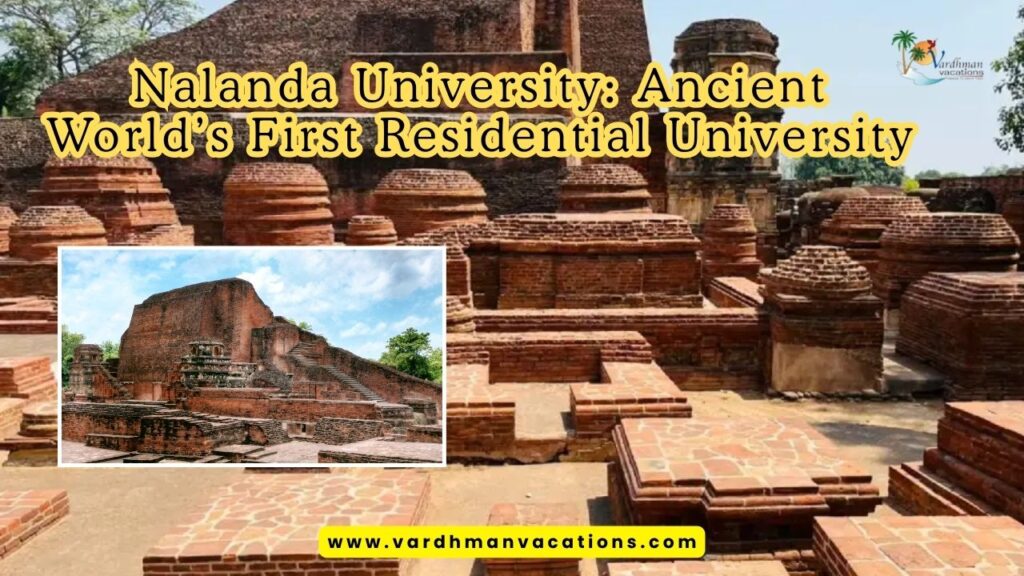
Nalanda University: Ancient World’s First Residential University – Complete History, Ruins Guide, Scholars, Destruction & Modern Revival (2026 Update)
Imagine a university that existed 1,600 years ago, drawing 10,000 students and 2,000 teachers from across Asia, housing millions of manuscripts in a nine-storey library, and teaching subjects from Buddhist philosophy to astronomy, medicine, and mathematics — centuries before Oxford or Bologna. This wasn’t a myth. This was Nalanda Mahavihara, the world’s first great residential university in Bihar, India.

Declared a UNESCO World Heritage Site in 2016, the Archaeological Site of Nalanda Mahavihara remains one of India’s most profound symbols of intellectual excellence. Whether you’re a history buff, Buddhist pilgrim, student of ancient education, or planning a Bihar heritage trip, this guide covers everything: founding, architecture, famous scholars, tragic destruction, excavations, global legacy, and the thriving modern Nalanda University in 2026.
Ready to step into 5th-century brilliance? Let’s dive deep.
The Founding and Golden Era of Nalanda University (427 CE Onwards)
Nalanda’s documented history begins around 427 CE during the Gupta Empire. Emperor Kumaragupta I (also called Shakraditya) established the mahavihara (great monastery) as a sangharama — a monastic-cum-educational complex. Successive Gupta rulers, including Budhagupta and Baladitya, expanded it with more monasteries and temples.
Later patrons included Emperor Harsha (7th century) and the Pala dynasty (8th–12th centuries), who turned Nalanda into a true international hub. Chinese pilgrim Xuanzang (Hiuen Tsang), who studied and taught here in 637 CE, described a massive brick-walled campus with one main gate and eight halls. Yijing (another Chinese visitor) noted eight viharas, each with 300 cells, and ten great pools.
At its peak, Nalanda hosted up to 10,000 students and 2,000 teachers (figures from pilgrim accounts; modern historians note possible exaggeration due to site scale). Students came from China, Korea, Japan, Tibet, Mongolia, Sri Lanka, Sumatra, and Central Asia. Admission was rigorous — oral interviews with gatekeepers tested intellect. Only the brightest entered.
Keyword fact: Nalanda operated continuously for nearly 800–1,000 years (5th to 13th/14th century CE), making it one of the longest-serving higher-learning institutions in history.
Architecture and Layout: A Masterclass in Ancient Planning
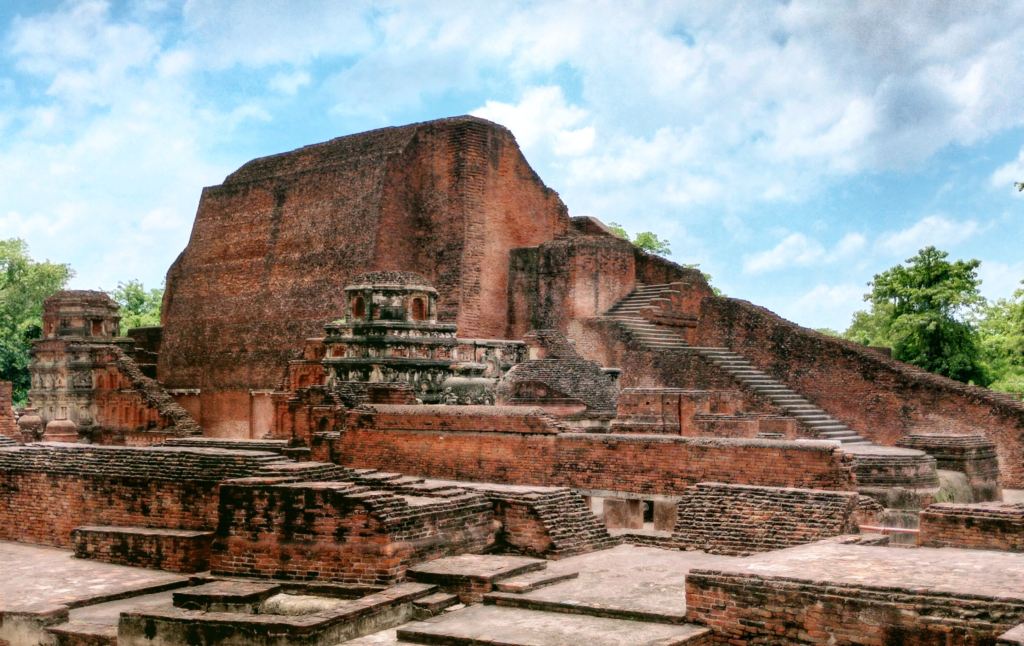
The excavated site spans 23 hectares (with a 57.88 ha buffer zone), revealing 11 viharas (monasteries) and 14 temples, plus stupas, shrines, and votive structures. The layout follows a strict north-south axis — a shift from earlier stupa-centered designs to formal linear planning that influenced later universities like Vikramshila and Paharpur.
- Viharas (Monasteries): Rectangular, with a central courtyard, verandah, and monk cells (each with a niche for lamps and letterboxes). Monastery 1 is the oldest, with nine occupation layers.
- Temple 3 (Sariputta Stupa): The star attraction — a massive multi-layered brick stupa dedicated to Buddha’s disciple Sariputta. Seven phases of construction, ornate stucco panels depicting Jataka tales, and surrounded by dozens of smaller votive stupas.

- Other highlights: Temple 2 with Hindu-Buddhist syncretic carvings (Shiva, Parvati, Gajalakshmi); evidence of metal-casting furnaces; colossal Buddha statues.
This standardized vihara design — quadrangular, residential-cum-educational — became the blueprint for Buddhist monastic architecture across South and Southeast Asia. UNESCO Criterion (iv) highlights exactly this innovation.
Curriculum: 64+ Subjects Taught at Nalanda
Nalanda wasn’t just Buddhist theology. It embraced a multidisciplinary approach embracing all contemporary knowledge systems. Core focus: Mahayana Buddhism (Madhyamaka, Yogachara, Sarvastivada). But students also mastered:
- Buddhist texts: Prajnaparamita Sutra, Guhyasamaja Tantra, Bodhisattvacaryāvatāra (by Shantideva).
- Secular subjects: Grammar (Vyakarana), logic (Hetuvidya), mathematics, astronomy, medicine (Ayurveda), alchemy, law, city planning, Vedas, Samkhya philosophy, and even magic/rituals.
Famous claim: 64 subjects were taught, including advanced doxographies and debate-based learning. Pedagogy relied on discussion, dialectics, and memorization — the same system preserved today in Tibetan monasteries.
Legendary Scholars and Global Visitors
Nalanda produced and hosted giants who shaped world thought:
- Nagarjuna (2nd–3rd century, traditionally linked): Founder of Madhyamaka philosophy.
- Aryadeva, Vasubandhu, Asanga: Key Mahayana thinkers.
- Dharmapala, Silabhadra, Shantideva: Eminent teachers.
- Aryabhata (speculatively linked): Pioneer of zero as a digit, trigonometry, and heliocentric ideas.
Xuanzang spent years here, studied under Silabhadra, and carried 657 scriptures back to China (translated into Chinese, influencing East Asian Buddhism). His disciple Dosho took teachings to Japan. Yijing documented daily monastic life.

Tibetan sources praise Nalanda as the source of all Buddhist knowledge in Tibet. The Dalai Lama has called it “the source of all the Buddhist knowledge we have.”
The Great Library of Nalanda: Dharmaganja
The crown jewel — Dharmaganja (“Mart of Piety”) — comprised three multi-storeyed buildings:
- Ratnasagara (9 storeys, “Ocean of Jewels”)
- Ratnodadhi and Ratnaranjaka
Hundreds of thousands (some accounts say 9 million) palm-leaf manuscripts on every subject. When a scholar died, their works were added. A 11th-century fire damaged it, but it was restored. Tibetan scholar Taranatha described one building “soaring into the clouds.”
Decline, Destruction, and the End of an Era
Multiple attacks hit Nalanda: Huns under Mihirakula (5th century), Gauda king of Bengal (8th century). But the final blow came around 1193–1200 CE when Turkic general Bakhtiyar Khilji raided it. According to contemporary historian Minhaj-i-Siraj (Tabaqat-i-Nasiri), Khilji mistook the fortress-like campus for a military stronghold and ordered it burned. The library reportedly smoldered for three months. Monks were killed or fled.
Tibetan monk Dharmasvamin visited in 1234 CE and found it partially functioning but devastated. Some scholars note Buddhism’s internal decline and Pala collapse contributed. Nalanda limped on until around 1400 CE before abandonment.
Rediscovery, Excavations, and UNESCO Glory
Buried for centuries, Scottish surveyor Francis Buchanan-Hamilton rediscovered it in 1812. Sir Alexander Cunningham identified it as ancient Nalanda in 1861. Systematic excavations by the Archaeological Survey of India (ASI):
- 1915–1937 (major digs)
- 1974–1982 (restoration)
Over 13,000 artefacts recovered — now in the onsite Nalanda Archaeological Museum (bronze Buddhas, stucco panels, inscriptions).

In 2016, UNESCO inscribed it under criteria (iv) and (vi) for its architectural innovation and role as the zenith of ancient higher learning.
Legacy: How Nalanda Changed the World
Nalanda exported knowledge:
- Buddhism to East and Southeast Asia
- Ayurveda and mathematics (zero, algebra) to Arabia and beyond
- Architectural models to monasteries in India, Nepal, Tibet, Indonesia
- Pedagogy of debate still alive in Tibetan tradition
It proved merit-based, residential, international education was possible 1,200 years before Europe’s universities.
Modern Nalanda University Revival – 2026 Update
In 2006, former President A.P.J. Abdul Kalam proposed revival. The Nalanda University Act 2010 passed; first students enrolled in 2014. The new 455-acre net-zero campus near Rajgir (designed by B.V. Doshi) opened fully in 2024, inaugurated by PM Narendra Modi. Solar-powered, rainwater harvesting, Vaastu-inspired architecture, 300 acres green + 100 acres water bodies.

Today it offers postgraduate and doctoral programs in Buddhist studies, ecology, historical studies, and more — attracting international students. 2026 events include workshops on ancient metallurgy and international seminars on soft power. Motto: “Learning is being here.” It revives the ancient spirit of global harmony and sustainable knowledge.
How to Visit Nalanda Ruins in 2026 – Practical Guide
Location: Nalanda, Bihar (90 km southeast of Patna, 12 km from Rajgir, near Bodh Gaya Buddhist circuit).
Best time: September to April (pleasant weather; avoid summer heat/monsoons).
Timings: Sunrise to sunset (typically 9:00 AM – 5:00 PM).
Entry Fees (ASI standard): ₹40 (Indians), ₹600 (foreigners). Museum extra or included.
How to reach:
- Patna airport/railway → taxi or bus (2–3 hours).
- Rajgir → auto/taxi (20–30 mins).
- Combine with Bodh Gaya/Rajgir for a perfect day trip.
What to see (2–3 hours needed):
- Walk the 800 ft × 1,600 ft excavated area
- Temple 3 (Sariputta Stupa)
- Monastery courtyards and cells
- Votive stupas
- Onsite museum (13,000+ artefacts)
Tips:
- Hire a local guide (₹200–300) — essential for context.
- No climbing on ruins; maintain silence.
- Carry water, wear comfortable shoes; photography allowed (gadgets need ASI permission in some areas).
- Visit early morning for fewer crowds and magical light.

Nearby: Nava Nalanda Mahavihara (modern monastic college), Rajgir hot springs, Bodh Gaya.
FAQs About Nalanda University
Was Nalanda really the world’s first university?
Yes — the first great residential university with organized higher learning, predating European ones by 500+ years.
Who destroyed Nalanda University?
Primarily Bakhtiyar Khilji around 1193–1200 CE, though earlier raids occurred.
Can you still study at Nalanda?
Yes! The revived Nalanda University offers modern degree programs.
Is the site worth visiting?
Absolutely — one of India’s most evocative UNESCO sites and a living link to ancient global education.
Conclusion: Nalanda’s Eternal Flame
From Gupta bricks to a 21st-century net-zero campus, Nalanda proves knowledge transcends time, borders, and even destruction. It gave the world zero, advanced Buddhism, and a model of inclusive excellence that still inspires.
Whether you walk its ancient ruins at sunrise or enroll in its modern programs, Nalanda reminds us: the pursuit of wisdom is humanity’s greatest legacy.
Plan your trip today with Vardhman Vacations + 91-9811175768 — book a Bihar Buddhist circuit tour and experience history that changed the world.
Share this guide if you loved learning about Nalanda! Have you visited the ruins? Drop your experience in the comments.