

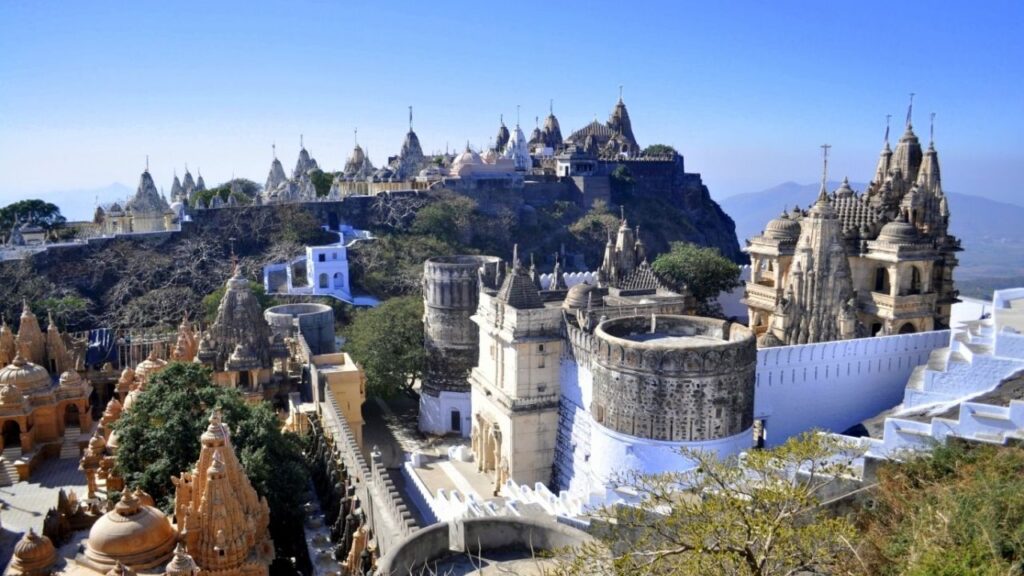
The Eternal Citadel of Jain Spirituality
Nestled amidst the arid landscapes of Gujarat, India, Shatrunjay Mahatirth—often simply called Shatrunjay or Palitana—stands as a towering testament to faith, resilience, and architectural brilliance. This sacred Jain pilgrimage site, perched on twin hilltops rising dramatically from the banks of the Shetrunji River, is not just a destination but a profound spiritual odyssey. Known as the “City of Temples,” Shatrunjay is home to over 1,300 exquisitely carved marble shrines, making it the world’s largest temple complex dedicated to Jainism. For Jains worldwide, it is the holiest of tirthas (pilgrimage sites), a place where countless souls are believed to have conquered their inner enemies—symbolized by the name Shatrunjaya, meaning “victor over foes”—and attained moksha (liberation). In this in-depth exploration, we’ll ascend the sacred steps together, unraveling its ancient history, mythical legends, intricate rituals, and the timeless allure that draws pilgrims from every corner of the globe.
The Mythical Genesis: Legends That Echo Through Eternity
Shatrunjay’s story transcends recorded history, weaving into the very fabric of Jain cosmology. According to sacred texts like the Shatrunjaya Mahatmya, the site’s origins predate even the advent of the first Tirthankara, Lord Rishabhanatha (Adinath), in the third kalpa (cosmic era) of the current time cycle. Legends whisper that the hills were once part of the grand Girnar range, a divine extension blessed by the gods themselves. The name Pundarikgiri (Lotus Mountain) harks back to Pundarik Swami, the first ganadhara (chief disciple) of Adinath and his grandson, who attained nirvana here on Chaitra Poornima. It is said that Adinath himself graced these peaks 99 times, delivering sermons that illuminated the path to enlightenment, and his son, Chakravarti Bharat—the first universal emperor—personally repaired the pilgrimage site after its primordial creation.
Deeper into the lore, Shatrunjay is revered as Siddhachala (Abode of the Perfected), where over 23 of the 24 Tirthankaras are believed to have meditated or achieved keval gyan (omniscience). On Kartik Poornima, saints like Dravid Varikhillaji and their legions of disciples ascended to moksha, their collective liberation filling the air with celestial vibrations. Another poignant tale unfolds on Falgun Shukla Trayodashi: Sri Samb and Sri Pradyumna, sons of Lord Krishna (destined to become a future Tirthankara), attained salvation on the peak known as Sadabhadra—now immortalized as Bhadvano Dungar. These narratives aren’t mere folklore; they infuse the site with an aura of divine inevitability, where every stone seems to pulse with the footsteps of enlightened beings. As one ancient verse from the Shatrunjaya Mahatmya proclaims, even thinking about Shatrunjay expiates sins, earning it over 108 alternate names like Vimalachala (Spotless Mountain) and Muktigeham (House of Liberation).
The Shetrunji River, flowing serenely at the base, mirrors this sanctity—likened in scriptures to the Vedic Ganga for its purifying waters. Bathing in its gentle currents before ascent is a ritual prelude, believed to amplify the pilgrimage’s fruits manifold.
A Tapestry of History: From Ancient Glory to Resilient Revival
While myths paint Shatrunjay’s eternal essence, history reveals a saga of devotion, destruction, and unyielding preservation spanning over 2,000 years. The site’s documented legacy begins around the 11th century CE, though Jain texts trace it to the 1st millennium BCE or earlier. The original wooden Adinath temple atop the hill was transformed into a resplendent stone marvel under the patronage of Kumarpala Solanki in the 12th century, with Vastupala and Tejapala—illustrious ministers of the Vaghela dynasty—overseeing expansions that added hundreds of shrines. These “tuks” (clusters) of temples, built by merchants, monks, and monarchs from the Tapagachchha sect, exemplify collective Jain philanthropy.
Yet, Shatrunjay’s path was not without trials. In 1299 CE, Alauddin Khilji’s forces ravaged the hill, reducing many temples to rubble. Undeterred, the Jain community, led by Shreshti Deshalji of Patan, rebuilt with fervor in the 14th century. By the 15th century, management shifted to Sajanshah of Khambhat, whose descendants ensured rituals continued amid political upheavals. A pivotal moment came in 1592 CE when Mughal Emperor Akbar, at the behest of Acharya Hiravijaya Suri, issued a firman (decree) granting Shatrunjay—and sites like Girnar and Abu—to the Jains, prohibiting animal slaughter and affirming its inviolable status.
The 19th century saw a golden renaissance under the Gaekwads of Baroda and British oversight, with over 300 temples restored or newly erected. Today, the Shri Shatrunjay Tirth Seva Samiti oversees this living heritage, balancing preservation with accessibility. Modern efforts include seismic reinforcements and eco-initiatives to combat erosion, ensuring Shatrunjay endures as a UNESCO-recognized jewel of intangible cultural heritage.
| Historical Milestones | Key Figures/Events | Impact |
|---|---|---|
| Pre-11th Century CE | Mythical visits by Adinath & Bharat Chakravarti | Establishes primordial sanctity; temples attributed to early Tirthankaras. |
| 12th Century CE | Kumarpala Solanki & Vastupala-Tejapala | Major expansions; Adinath temple rebuilt in stone; over 200 shrines added. |
| 1299 CE | Raid by Alauddin Khilji | Destruction of many temples; sparks resilient reconstruction. |
| 1592 CE | Akbar’s Firman via Hiravijaya Suri | Legal protection; bans non-vegetarian practices, solidifying Jain control. |
| 19th Century CE | Gaekwad patronage & British era | 300+ temples restored; modern pathways introduced. |
| Present Day | Shatrunjay Tirth Seva Samiti | Conservation projects; annual yatras draw lakhs of pilgrims. |
Architectural Symphony: A Marble City Etched in Devotion
Ascending Shatrunjay is to step into a three-dimensional mandala of faith. The complex sprawls across two peaks—Anandachala and Siddhachala—linked by a saddle-like valley, with temples clustered in nine majestic tuks. Crafted predominantly from luminous white marble sourced from nearby quarries, these structures embody the Maru-Gurjara (Solanki) style: soaring shikharas (spires), lattice-work jalis (screens), and motifs of lotuses, elephants, and celestial beings. Though individually they may not rival the filigree of Dilwara or Ranakpur, their sheer profusion—over 1,300 shrines—creates a hypnotic skyline visible for miles.
At the pinnacle sits the Adinath Temple (Mulnayak), a 16th-century masterpiece housing a 2.16-meter serene idol of Rishabhanatha in padmasana (lotus pose), his white marble form radiating ethereal calm. Flanking it are the Chaumukh Temple (Khartarvasahi Tunk), with its iconic four-faced idol symbolizing omnipresence, and the Pundarik Swami Shrine, a humble yet potent reminder of ancient nirvanas. Other gems include the Parshvanath Temple with its hooded serpent carvings and the Ramachandji Temple, blending Jain and Hindu iconography in harmonious syncretism. Pathways wind through pillared mandapas (halls) adorned with narrative friezes depicting Tirthankara lives—each step a meditation on impermanence.
The back side harbors Gheti ni Pag (Lord’s Footprints), ancient imprints of Adinath etched into rock, accessible via a secondary stairwell that doubles the pilgrimage’s merit. From the summit, panoramic views of the Gulf of Khambhat and Saurashtra plains unfold, a visual metaphor for transcending worldly bounds.
The Pilgrim’s Ascent: Rituals, Rites, and Sacred Circuits
Shatrunjay demands surrender—body, mind, and soul. The journey begins at dawn with a purifying dip in the Shetrunji, followed by darshan at the base’s Agama Temple (repository of Jain scriptures). Pilgrims then tackle the 3,774 stone steps—carved arduously into the 600-meter hills—spanning 3.5 km and taking 1.5–2 hours. No vehicles intrude; only porters (dolis) assist the infirm, preserving the site’s ascetic ethos. En route, chabutros (bird feeders) and water kundas underscore ahimsa (non-violence), even for feathered kin.
At the crest, rituals unfold in layered devotion. Core practices include darsan (viewing idols), aarti (lamp offerings), and pradakshina (circumambulation) of key shrines. Monks chant stutis (hymns) like the 21 duhas of Siddhachala Stotra, invoking the hill’s 108 names. Fasting—upvas or ayambil (one-meal days)—amplifies spiritual potency, while alms to mendicants fulfill dana (charity).
The Navanu Yatra elevates this to transcendence: devout Jains undertake 99 ascents over a lifetime, emulating Adinath’s visits, culminating in a “hundredth” symbolic circuit. Three parikramas (circumambulations) vary in scale:
- Chhota Parikrama: 4.8 km around the base tuks.
- Maha Parikrama: 19.3 km encircling both peaks.
- Brihat Parikrama: 38.6 km, enveloping the entire hill range.
Annual festivals ignite the site. The Kartik Poornima Yatra (October–November) sees thousands circumambulate 216 km around the hills in a week-long procession, a once-in-lifetime teerth yatra. Fagun Sud Teras (February–March), or Chh Gaon Jatra, draws over a lakh pilgrims in a vibrant march from Adipur village—Adinath’s legendary halt—complete with chariots, hymns, and puja for salvation. Monsoon closure (June–September) allows nature’s respite, reopening with triumphant fanfare.
| Ritual Type | Description | Spiritual Merit |
|---|---|---|
| Darsan & Puja | Idol veneration with flowers, incense, and chants. | Direct communion with Tirthankaras; sin dissolution. |
| Ayambil/Upvas | Restricted fasting during ascent. | Detoxifies karma; enhances focus. |
| Parikrama Circuits | Foot circumambulation of tuks or hills. | Mirrors life’s journey; multiplies pilgrimage fruits. |
| Navanu Yatra | 99 ascents + symbolic 100th. | Attainment of moksha-like purity. |
| Festival Processions | Chariot parades on Poornima days. | Collective energy; ancestral blessings. |
Echoes of Eternity: Why Shatrunjay Endures
In an era of fleeting distractions, Shatrunjay Mahatirth remains an anchor of introspection. Its marble spires, etched with millennia of devotion, remind us that true victory lies not in conquest but in conquering the self. For the weary pilgrim, the climb is cathartic; for the seeker, it’s revelation. As the sun dips below the Gulf of Khambhat, casting golden hues on the shikharas, one feels the pulse of infinite liberations—Pundarik’s nirvana, Adinath’s sermons, the silent triumphs of uncounted souls.
Whether you’re a devout Jain charting your Navanu or a curious traveler awed by human ingenuity, Shatrunjay invites you to pause, reflect, and rise. In its quietitude, amid the rustle of palm fronds and distant chants, the hill whispers: Siddhachala samaru sada—the abode of the perfected endures forever. Plan your ascent; the steps await, leading not just upward, but inward.