

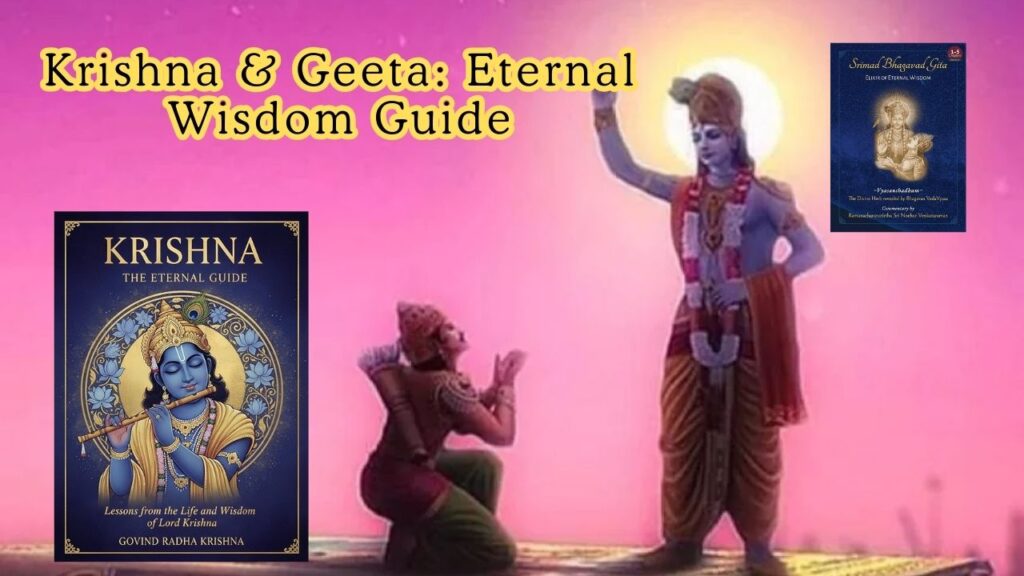
The Bhagavad Gita, often simply called the Gita or Geeta, stands as one of the most profound and influential spiritual texts in human history. Embedded within the ancient Indian epic Mahabharata, it is a 700-verse dialogue that unfolds on the battlefield of Kurukshetra, just before a cataclysmic war. At its heart is Lord Krishna, who serves as both charioteer and divine guide to the warrior prince Arjuna.
The Setting: A Crisis of Conscience
The story begins with Arjuna, a skilled archer and key figure in the Pandava army, facing an agonizing moral dilemma. He sees relatives, teachers, friends, and cousins arrayed on the opposing Kaurava side. Overwhelmed by grief and compassion, he drops his bow (Gandiva) and refuses to fight, fearing the destruction of family bonds, societal order (dharma), and the sin of killing kin. This moment of deep inner conflict—known as Arjuna Vishada Yoga (the Yoga of Arjuna’s Grief)—sets the stage for one of the greatest philosophical conversations ever recorded.
Arjuna turns to Krishna, his lifelong friend and advisor, for guidance. Krishna, revealed as an incarnation (avatar) of Lord Vishnu, the preserver in the Hindu trinity, responds not just as a friend but as the Supreme Divine Himself. What follows is the Bhagavad Gita: Krishna’s timeless teachings that transform Arjuna’s despair into resolute action and spiritual clarity.
Krishna’s Central Role
Krishna is far more than a charioteer or strategist in the Mahabharata. In the Gita, he embodies the Supreme Being (Bhagavan), the ultimate reality, and the personal God who descends to restore righteousness (dharma) whenever it declines. His significance lies in several layers:
- Divine Teacher and Guide — Krishna does not force Arjuna to fight; instead, he awakens him through reason, wisdom, and revelation. He patiently addresses Arjuna’s doubts, leading him from confusion to enlightenment.
- Revealer of Ultimate Truth — Krishna discloses profound metaphysical truths: the eternal nature of the soul (atman), the impermanence of the body, the cycle of birth and death (samsara), and the paths to liberation (moksha).
- Personification of Love and Devotion — Through bhakti (devotional surrender), Krishna offers the simplest yet most direct path to the divine. He declares that complete surrender to him frees one from all sins and leads to eternal union.
- Cosmic Form (Vishvarupa) — In Chapter 11, Krishna grants Arjuna a divine vision of his universal form—containing all existence, time, creation, and destruction—affirming his supremacy as the source and end of everything.
Krishna’s teachings synthesize diverse strands of Indian philosophy: duty (dharma) from Vedic tradition, knowledge (jnana) from the Upanishads, disciplined action (karma yoga) from Samkhya-Yoga, and loving devotion (bhakti)—making the Gita a unique bridge across paths.
Core Significance of the Bhagavad Gita
The Gita is revered as the essence of Vedic wisdom, often called the “Song of God” (Bhagavad = of the Lord, Gita = song). Its importance spans spiritual, philosophical, ethical, and practical dimensions:
- Universal Spiritual Guide — Though deeply rooted in Hinduism, its messages transcend religion. It addresses universal human struggles: duty vs. emotion, action vs. inaction, attachment vs. detachment, fear of death, and finding purpose amid chaos.
- Paths to Liberation — Krishna outlines multiple yogas (disciplines) for self-realization:
- Karma Yoga — Selfless action without attachment to results (perform duty for duty’s sake).
- Jnana Yoga — Path of knowledge, realizing the eternal soul beyond the body.
- Dhyana/Raja Yoga — Meditation and mind control.
- Bhakti Yoga — Devotion and surrender to the Divine (Krishna calls this the highest and easiest in the modern age).
- Timeless Relevance — The Gita speaks to modern dilemmas—stress, ethical conflicts, leadership, work-life balance, resilience, and inner peace. Leaders like Mahatma Gandhi drew inspiration from its principle of non-attached action; thinkers worldwide (from Emerson to Oppenheimer) have admired its depth.
- Synthesis of Hindu Thought — It harmonizes seemingly opposing ideas: action in the world vs. renunciation, personal God vs. impersonal absolute, duty vs. liberation. This makes it a pan-Hindu text with unparalleled influence.
Key Teachings from Krishna
Some enduring messages include:
- The soul is eternal and indestructible: “Weapons cannot shred the soul, nor can fire burn it. Water cannot wet it, nor can the wind dry it.” (2:23)
- Perform your duty without attachment to outcomes: “You have a right to perform your prescribed duties, but you are not entitled to the fruits of your actions.” (2:47)
- Equanimity in success and failure: Stay balanced in pleasure/pain, victory/defeat.
- Surrender leads to grace: “Abandon all varieties of dharma and simply surrender unto Me. I shall deliver you from all sinful reactions.” (18:66)
Enduring Legacy
The Bhagavad Gita has inspired countless commentaries (from Adi Shankaracharya to modern interpreters), translations in every major language, and movements like Bhakti traditions. It remains a manual for living with purpose, courage, and devotion—reminding us that the real battlefield is within the mind and heart.
Krishna and the Gita together represent divine compassion meeting human struggle: God descends not to dictate, but to awaken. In doing so, they offer eternal wisdom—that true victory lies not in winning wars, but in aligning one’s life with higher truth, duty, and love.


